
IMMEDIATE HELP LINE: (206) 571 7580
If you’re seeing swarming ants, large trails, or suspect structural damage, you need emergency ant control. We provide same day emergency service for Seattle homes and businesses with active ant infestations.
EMERGENCY INDICATORS (Call Now If You See These):
- ✓ Ants swarming inside your home
- ✓ Large visible trails (50+ ants)
- ✓ Carpenter ant frass (sawdust piles)
- ✓ Ants in electrical outlets (fire hazard)
- ✓ Rustling sounds in walls at night
- ✓ Sudden massive appearance after rain
Ants Suddenly Everywhere After Seattle Rain? Here’s Exactly What’s Happening
It happened fast. Yesterday there were a few ants near the kitchen sink. This morning, after last night’s rain, there are hundreds trailing across the counter, coming up through the baseboard, appearing from somewhere you can’t identify.
This is one of the most common calls we receive, and it happens on a predictable schedule every time Seattle gets a heavy rainfall. You haven’t done anything wrong. Your house isn’t unusually dirty. What you’re seeing is a specific, well documented ant behavior that the Pacific Northwest climate triggers reliably and it requires a specific response to stop.
Call (206) 571 7580 for same day service. Read on to understand exactly what’s happening and why the spray under your sink will make it significantly worse.
Why Seattle Rain Causes Sudden Ant Explosions Indoors
Odorous house ants the small dark ant responsible for the vast majority of Seattle kitchen infestations nest in soil, under mulch, beneath concrete slabs, and inside wall voids near moisture. When heavy rain saturates the ground, two things happen simultaneously:
First, soil nests flood. Ants don’t drown they evacuate. A flooded outdoor nest sends thousands of workers scrambling for higher, drier ground. The nearest option is usually your home’s foundation, slab gaps, or wall penetrations.
Second, the barometric pressure drop that precedes rain increases ant foraging activity. Colonies sense the weather change and send out more scouts before the rain hits which is why you sometimes see the first ants the evening before a heavy rainfall, not the morning after.
The result: what was a small, manageable colony living quietly under your front walkway becomes an overwhelming indoor invasion in the space of a few hours. The colony didn’t grow overnight. It relocated.
The Worst Thing You Can Do Right Now
Reach for the Raid.
Odorous house ants which is almost certainly what you have if they appeared suddenly after rain and you’re in Seattle respond to repellent spray by splitting the colony. The chemical signal triggers a survival behavior called budding: the queen produces multiple sub queens, each takes a portion of the workers, and the colony fragments into several new nests in different locations.
The spray kills the ants you see. But within 48 to 72 hours, you now have three or four active nests where you had one. Homeowners who spray after a rain event consistently report that the second wave is worse than the first.
The correct response slow acting bait that workers carry back to all nests is counterintuitive because it means leaving visible ants alone while the bait works. A professional does this correctly. DIY bait products use incorrect formulations or get placed in the wrong locations and rarely achieve colony elimination.
What to Do While You Wait for the Technician
If you’ve called (206) 571 7580 and a technician is on the way, here’s how to help not hinder the process:
-
Do not spray anything. Not Raid, not Windex, not peppermint oil, not vinegar. Anything that disrupts the pheromone trail makes it harder to trace the colony to its origin.
-
Do not block entry points yet. Sealing gaps before treatment traps ants inside the wall. Exclusion happens after treatment, not before.
-
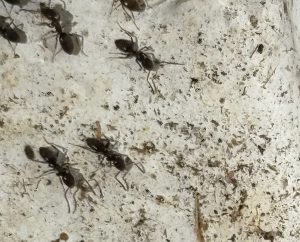
Do photograph the trails. A photo showing where ants are entering and the trail direction helps the technician identify the nest location faster. Text photos to (206) 571 7580.
-
Do remove accessible food. Seal anything open on counters. This doesn’t solve the problem but reduces reinforcement foraging while bait is being placed.
-
Do note where the trail started. The origin point a gap at the baseboard, a crack near the dishwasher, a spot near the sliding door is the most useful information you can give the technician.
Seattle’s Rain Driven Ant Calendar
If you understand when this happens, you can protect against it before it starts:
| Season | What triggers it | What you’ll see |
|---|---|---|
| Late February – March | First heavy rains after dry winter | Scouts appearing inside, especially near sinks |
| April – May | Sustained spring rainfall | Full trail invasions after overnight rain events |
| June – July | Pre-summer pressure drop storms | Carpenter ant swarm season large winged ants indoors |
| September – October | First fall rains after dry summer | Second major invasion season colonies relocating before cold |
| November – December | Winter saturation events | Moisture ants appearing in bathrooms often indicates a leak |
The two highest risk windows are April–May and September–October. If you’ve had ants before, a preventive perimeter treatment applied before these windows is significantly cheaper than emergency treatment after an invasion.
When It’s More Than Just Rain Flushed Ants
Most post rain invasions are odorous house ants and resolve cleanly with one professional bait treatment. But some are a sign of something more serious. Call (206) 571 7580 same day don’t wait if you see any of these alongside the ants:
Large black ants (6mm) with piles of sawdust nearby. This is carpenter ant frass. Rain flushed carpenter ants mean an established colony is nesting inside or under your home’s wood structure. This is a structural damage situation, not just a nuisance. See our carpenter ant extermination page.
Yellow or light brown ants appearing near a bathroom or under a sink. These are likely moisture ants, which nest in wood that is already wet and rotting. Their appearance signals an active water leak or drainage problem somewhere in the structure. See our moisture ant control page.
Ants coming from an electrical outlet or switch plate. This is a same day call situation regardless of species. Ant colonies nesting inside electrical voids create a genuine fire risk. Do not attempt to treat this yourself.
Winged ants indoors in large numbers. Swarms of winged ants (alates) mean a mature colony is producing reproductives either carpenter ants in May–July or odorous house ants in late summer. Swarming indoors means the primary nest is inside or immediately adjacent to the structure.
What Same Day Treatment Looks Like
When you call before 2pm, here is what happens:
A technician arrives with moisture detection equipment, inspection tools, and species-appropriate bait not a spray bottle. The first 20 minutes are spent tracing the trail to its origin, not immediately treating what’s visible. Species is confirmed on-site. Bait is placed at trail locations and near the entry point. A perimeter barrier is applied outside at foundation level.
You’ll see a reduction in activity within 24–48 hours as foragers encounter the bait. Full colony elimination takes 1–4 weeks. We include one free follow-up if activity continues beyond that window.
There is no surcharge for same day service. The price is the same as a scheduled appointment.
Protecting Your Home Before the Next Rain Event
One professional treatment eliminates the current invasion. Preventing the next one requires addressing the conditions that make your home the destination when it rains:
Perimeter moisture management. Gutters draining against the foundation, negative grade, and standing water near the slab all create the saturated soil conditions that flush ants inside. A downspout extension costs $15. A professional ant treatment costs $200–$300.
Mulch distance from foundation. Bark mulch beds touching the foundation stay wet after rain and provide shelter for colonies that are one flood away from relocating inside. Six inches of clearance changes this.
Slab and utility gap sealing. After treatment, gaps at plumbing penetrations, expansion joints, and utility conduits should be sealed with appropriate caulk or foam. This is the step that turns a one time treatment into lasting protection.
Preseason preventive treatment. A perimeter barrier applied in late March and again in late August before the two main rain driven invasion windows is significantly more effective and less expensive than reactive emergency treatment.
See our full ant extermination services page for maintenance plan options and pricing.
Frequently Asked Questions
Is this just going to happen again next time it rains?
If the colony that flushed inside is eliminated not just disrupted the same colony won’t return. However, new colonies in the soil around your home can establish and repeat the cycle. Seasonal preventive perimeter treatment is the most reliable way to break this pattern. One treatment eliminates the current infestation. Ongoing quarterly treatment prevents future ones.
The ants disappeared on their own after a day. Do I still need treatment?
Sometimes rain flushed ants return to outdoor nests once conditions dry out. If they disappear within 24–48 hours without treatment, the colony likely retreated. However, this means a mature colony is established within foraging distance of your home and it will return at the next major rain event, each time better oriented to your food and water sources. A preventive treatment now is less disruptive than an emergency treatment in April.
My neighbor sprayed and their ants disappeared. Why do you say not to spray?
Your neighbor’s ants may have temporarily retreated from the spray zone. The colony is still there. Many homeowners report the problem “going away” after spraying, then reappearing worse three to four weeks later which is the budded satellite colonies establishing and expanding. Short-term disappearance after spray is not elimination.
How quickly can you get here?
For calls received before 2pm, same day service is standard across Seattle and most of King County. Call (206) 571 7580 and we’ll confirm the arrival window at time of booking.
Do you serve the Eastside?
Yes. Bellevue, Kirkland, Redmond, Sammamish, Issaquah, and Bothell are all covered. See our Eastside ant exterminators page for Eastside specific response times.
Related Pages
Call (206) 571 7580 Same day service, no surcharge, free inspection. Serving Seattle, Bellevue, Kirkland, Redmond, Sammamish, Issaquah, and all of King County.