Carpenter Ant Exterminator in Clyde Hill, WA Structural Inspection, Root Cause Treatment & Moisture Analysis
AMPM Exterminators | Licensed Eastside pest control operator | 20+ years King County experience Same day service | Residential & commercial | Structural inspection included | 30 day warranty | Mon–Sun 6 AM–2 AM
(206) 571 7580 | Email | ampmexterminators.com
What Are Carpenter Ants and Why Is Clyde Hill One of the Highest Risk Communities on the Eastside?
Carpenter ants (Camponotus spp.) are wood excavating insects not wood eating ones. They hollow out galleries inside softened or moisture-damaged wood to build nesting chambers. A single established colony can remove two to three cubic feet of structural wood over three to five years making delayed treatment one of the costliest pest mistakes Clyde Hill homeowners make.
Clyde Hill sits at an elevated ridge position above Lake Washington’s eastern shore, with its apex reaching 375 feet. That elevation delivers sweeping views of the Olympic Mountains, the Seattle skyline, and Lake Washington but it also places Clyde Hill’s estates directly in the path of the persistent moisture cycling that moves off the lake year-round. Homes along the western-facing slopes catch lake moisture through the fall and winter months at a higher rate than most other 98004 zip communities.
Three overlapping conditions make Clyde Hill a structurally elevated risk zone for carpenter ants conditions distinct from neighboring Medina, Yarrow Point, and Bellevue proper:
Pre-code housing stock concentrated on high-value lots. Most Clyde Hill homes were built in the 1960s and 1970s, before modern moisture management standards were codified into Washington State building requirements. These homes have been cycling through Pacific Northwest wet seasons for 50–60 years and original exterior wood siding, crawlspace framing, deck ledger boards, and window surrounds in homes of this age are at or well past the wood moisture thresholds that carpenter ants use as a nesting trigger.
Estate-scale landscaping with full irrigation coverage. Clyde Hill’s lots ranging from 7,000 to 36,000 square feet are professionally maintained with mature plantings, hedgerows, and automated irrigation systems. AMPM Exterminators’ Eastside data shows that properties running irrigation daily or every other day average 5–7 active ant colonies in foundation plantings. That saturated soil condition against Clyde Hill’s large foundation perimeters maintains the 15%+ wood moisture content carpenter ants require to establish satellite colonies inside structural framing.
Dense mature tree canopy abutting structures. Clyde Hill’s privacy focused streetscape is defined by mature ornamental trees, 10 foot hedgerows, and wooded screening. Rotting stumps, dead limbs, and decayed wood in mature landscaping within 100 feet of a structure are the most common outdoor parent colony location in every carpenter ant infestation we treat on the Eastside. On Clyde Hill’s larger estate properties, the outdoor nesting habitat is effectively unlimited.
A single established carpenter ant colony inside a Clyde Hill wall void represents a $5,000–$15,000+ structural repair risk if allowed to progress to years three through five. At $400–$900 for professional treatment in year one, early intervention is one of the highest-return decisions a Clyde Hill homeowner can make.
How to Identify Carpenter Ants in Your Clyde Hill Home
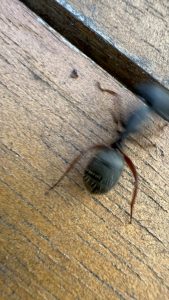
The fastest identification test: if the ant is noticeably large — ¼ to ½ inch solid black or black with a reddish midsection, and found near a moisture source such as a bathroom, kitchen sink, leaking window frame, or crawlspace access point, it is almost certainly a carpenter ant. No other ant species common to the Eastside reaches that size.
Visual Identification Checklist
- Size: ¼–½ inch for workers; queens up to ⅝ inch. Within a single colony, minor workers (~¼ inch) and major workers (~½ inch) coexist
- Color: Solid black, or black with a reddish orange midsection (Camponotus modoc, the most common Pacific Northwest species, is solid black)
- Waist: Clearly pinched and narrow between thorax and abdomen distinct from the thick, straight body of a termite
- Antennae: Distinctly elbowed, bending at roughly 45 degrees
- Thorax profile: Smooth, evenly rounded on top no bumps or spines
Behavioral Signs That Confirm Active Nesting Inside Your Clyde Hill Home
Frass is the most definitive indoor sign. Coarse, pencil-shaving-like sawdust mixed with insect body parts accumulating in small piles near wall outlets, baseboard seams, or window sill corners confirms active excavation inside structural wood. If you are finding frass in a Clyde Hill home built in the 1960s or 1970s, the colony has almost certainly been active for more than one season.
Nocturnal wall noise a faint rustling or crinkling sound inside walls between 10 PM and 2 AM is workers actively moving through and enlarging gallery channels. This sound is most often reported near bathrooms, exterior walls, and the sill plate area above the crawlspace.
Indoor swarmers winged carpenter ants emerging inside the home between March and June indicate an established, mature colony that has reached reproductive capacity. This typically means the colony is two to three or more years old and satellite colonies are already active in multiple locations within the structure. Ten or more swarmers inside is a reliable indicator of a significant indoor infestation.
Carpenter Ants vs. Termites in Clyde Hill: How to Tell Them Apart
Quick answer for Clyde Hill homeowners: Subterranean termites are present in King County but far less common than carpenter ants. Finding coarse sawdust like frass almost always means carpenter ants. Finding pencil width mud tubes along your foundation wall means termites. The two require completely different treatment protocols misidentification leads to the wrong treatment, wasted cost, and continued structural damage.
| Feature | Carpenter Ant | Subterranean Termite (King County) |
|---|---|---|
| Size | ¼–½ inch workers; ⅝ inch queens | ⅛–¼ inch workers |
| Color | Black or black and red | Cream / pale white |
| Waist | Clearly pinched, narrow | Broad no visible waist |
| Antennae | Elbowed (bent ~45°) | Straight, bead-like |
| Evidence | Coarse frass (sawdust + body parts) | Pencil-width mud tubes on foundation |
| Swarmers | Large; front wings longer than rear | Smaller; all four wings equal length |
| Common on Eastside? | Very common | Present but uncommon |
| Speed of damage | Slower (3–5 year timeline) | Faster in warm climates; slower in PNW |
If you are unsure whether what you are seeing in a Clyde Hill home is carpenter ants, termites, or moisture ants, do not guess call AMPM Exterminators for a professional identification. Our Building & Structural Pest Inspections provide a definitive answer before any product is applied.
What Structural Damage Do Carpenter Ants Actually Cause in Clyde Hill Homes?
Carpenter ants target wood that is already moisture-compromised — and in Clyde Hill’s 1960s–1970s estate homes, that wood is frequently structural. Bathroom wall studs softened by a slow shower-pan leak. Crawlspace support posts with failing original vapor barriers. Deck ledger boards exposed to irrigation overspray. Garage door headers under a gutter drip line. Sill plates and rim joists at the foundation edge. These are load-bearing components repairs here are structural, not cosmetic, and in a Clyde Hill home valued at $2M–$12M, the math of delayed treatment is punishing.
The Five-Year Damage Progression in a Clyde Hill Home
Year 1: Parent colony establishes outdoors in a rotting ornamental stump, a dead section of a hedge tree, or a deteriorated wood landscape edging within 100 feet. 50–100 workers. No structural damage to the home yet.
Years 2–3: Colony grows to 500–1,000 workers. Satellite colonies smaller worker groups sent from the parent establish inside moisture compromised wall cavities or crawlspace framing. Excavation begins. Frass may start appearing at baseboards or outlets. Visible damage is minimal but active.
Years 3–5: Parent colony reaches 2,000–3,000 workers. Multiple satellite colonies active across the structure. Wall studs, window frames, and crawlspace timbers show significant hollowing. Frass piles become visible. Repair costs typically $5,000–$10,000 in a home of this age.
Year 5+: Severe structural compromise. Sagging floors, soft wall spots, visibly affected framing members. Repair costs $10,000–$15,000+ plus contractor and potentially structural engineering fees.
Most Frequently Damaged Locations in Clyde Hill Homes
- Bathroom wall studs shower moisture and slow pan leaks are the #1 carpenter ant moisture source in Clyde Hill’s original 1960s–1970s construction
- Crawlspace support posts and floor joists original vapor barriers at or past end of life; ground moisture rising through deteriorated plastic sheeting
- Deck posts, beams, and ledger boards Clyde Hill’s estate properties have extensive decking; ledger board connections without proper flashing cap are the most commonly missed moisture entry point
- Exterior sill plates and rim joists irrigation overspray against foundations is a major driver specific to Clyde Hill’s professionally landscaped properties
- Garage door headers gutter drip lines above garage doors on Clyde Hill’s multi-car estate garages create a chronic moisture exposure point
- Window frames and sills original single pane windows with failed exterior caulking condense moisture directly into wood frames throughout every Eastside winter
- Under-sink kitchen walls supply line pinhole leaks accumulate inside base cabinets for months; first sign is often carpenter ant frass behind the cabinet floor
Why early treatment matters economically in Clyde Hill: Treatment in year one of visible activity costs $400–$900. Delaying to year three or four adds $5,000–$10,000 in structural repairs that pest control cannot address those require a licensed general contractor, and in severe cases a structural engineer. On a $5M Clyde Hill estate, protecting structural integrity is not a discretionary decision.
Carpenter Ant Treatment Cost in Clyde Hill, WA
AMPM Exterminators carpenter ant treatment for Clyde Hill properties costs $400–$600 for a standard single-colony treatment, $600–$900 when structural inspection and moisture analysis are added, and $900–$1,500 for severe multicolony infestations in larger estate homes.
| Service Tier | Price Range | What’s Included |
|---|---|---|
| Standard | $400–$600 | Interior exterior inspection, outdoor parent colony treatment, non repellent foundation perimeter barrier, written report, 30 day warranty |
| With Structural Inspection ★ Most common for Clyde Hill | $600–$900 | Everything in Standard + moisture meter readings on all suspect wood, wall-void dust treatment, photo documentation of all damage, repair + contractor referrals, moisture source identification |
| Severe / Multi-Colony | $900–$1,500 | Multi-visit program, extensive wall void + crawlspace treatment, moisture correction planning, contractor coordination, 90-day follow-up inspection included |
For Clyde Hill’s 1960s–1970s estate homes especially those with vented crawlspaces, original plumbing, and mature landscaping the Structural Inspection tier is the appropriate starting point. These homes have the construction characteristics that most commonly produce hidden multi-location infestations.
Why Hardware Store Products Cost More in the Long Run on Clyde Hill Properties
Consumer grade ant sprays use repellent pyrethrins that ants detect and avoid. When a colony encounters a repellent barrier, it does not die it subdivides. Workers route around the treated area and establish new satellite colonies on the opposite side. Clyde Hill homeowners who spray and then find the infestation has spread to a different wall section are observing exactly this outcome.
Six months of hardware store products typically runs $200–$400 with no structural resolution, while the colony continues excavating load-bearing framing. A single professional treatment at $400–$600 eliminates the colony rather than relocating it and includes a 30 day warranty.
How AMPM Exterminators Treats Carpenter Ants in Clyde Hill: The 5 Step Root Cause Method
Eliminating a carpenter ant infestation in a Clyde Hill estate home requires treating both the outdoor parent colony and all indoor satellite colonies simultaneously, using non repellent professional formulations that spread through normal colony behavior grooming and food sharing rather than repelling ants away from treated surfaces.
Step 1: Full Property Structural Inspection (30–60 Minutes)
Moisture meter readings on all suspect wood throughout the property. Exterior survey of all trees, stumps, ornamental hedgerows, and wood features within 100 feet. Interior examination of all moisture-prone spaces bathrooms, under-sink areas, crawlspace, window frames, and garage. Written report with photos, damage severity assessment, and repair recommendations. For Clyde Hill’s larger estate properties with extensive landscaping and outbuildings, this step may extend the inspection window.
For properties where a formal structural report is needed for real estate disclosure, insurance documentation, or pre-renovation assessment see our Building & Structural Pest Inspections service.
Step 2: Outdoor Parent Colony Treatment
Professional dust insecticide introduced into the primary nest almost always in a rotting stump, dead tree section, or deteriorated wood feature within 100 feet of the structure spreads to workers, reproductives, and the queen through normal colony grooming and food sharing. All secondary outdoor nesting sites on the property are treated simultaneously. On Clyde Hill’s larger lots with mature hedgerow screening and ornamental trees, multiple outdoor nesting zones may be present.
Step 3: Wall Void Satellite Colony Treatment
Dust formulations injected through baseboard-level drill points settle throughout wall void spaces and are picked up by workers moving through gallery channels reaching egg chambers and colony areas that no surface spray can access. This is the only effective approach for the satellite colonies established inside Clyde Hill’s older wall assemblies. Colony elimination typically takes 10–14 days.
Step 4: Non Repellent Foundation Perimeter Barrier
A liquid non repellent treatment applied around the full foundation perimeter prevents new foragers from re-entering the structure. Unlike repellent formulas which ants detect and avoid, forcing them to route through gaps you didn’t treat non repellent perimeter treatments are undetectable to foraging workers, allowing them to pass through and carry active material back into the colony. Effective for approximately 90 days. On Clyde Hill’s larger estate foundations, full perimeter coverage requires additional product volume; this is built into our Clyde Hill pricing.
Step 5: Moisture Source Identification and Written Correction Plan
Because carpenter ants select nesting sites based on wood moisture content, every treatment includes a written moisture correction plan addressing the specific sources identified during inspection irrigation programming, gutters, plumbing, crawlspace vapor barriers, drainage grading, or window caulking as applicable. Without correcting the moisture condition, a new colony can establish in the same location within one to two seasons. Contractor referrals provided for all identified repair categories.
For properties where moisture ants are also present alongside carpenter ants a common finding in Clyde Hill’s older crawlspace equipped homes
see our Moisture Ants Control Seattle page. Both species can be addressed in a single service call.
Carpenter Ant Prevention for Clyde Hill Estate Properties What Actually Works
Eliminate Outdoor Nesting Habitat
- Grind or remove all stumps within 50 feet of the structure including ornamental stumps used as landscape features
- Remove dead or dying sections from mature trees within 100 feet; in Clyde Hill’s privacy hedgerow trees, dying interior sections are a primary parent colony location
- Replace rotting fence posts, deteriorated wood landscape edging, and degraded timber retaining walls
- Store firewood at least 20 feet from the structure on an elevated platform with no ground contact
- Pull mulch back 6 inches from the foundation perimeter on Clyde Hill’s professionally landscaped properties, deep mulch beds pressed against the foundation are one of the highest risk carpenter ant attractors
Reduce Wood Moisture Content
- Clean gutters in April and November Seattle’s optimal timing before and after heavy rainfall seasons
- Ensure downspouts discharge at least 5 feet from the foundation; on Clyde Hill’s larger lots, extend downspout runs to discharge away from all planted beds near the foundation
- Repair plumbing leaks within 48 hours of detection slow leaks beneath sinks and behind shower walls in Clyde Hill’s original 1960s–1970s plumbing are the most common carpenter ant moisture source
- Adjust irrigation programming to avoid overwatering within 18 inches of the foundation; on Clyde Hill properties running daily irrigation, reducing frequency to three times weekly significantly reduces sub foundation soil moisture
- Inspect and replace crawlspace vapor barriers that have deteriorated in Clyde Hill’s 50-60 year old homes, original vapor barriers are almost certainly no longer functional
Seal Entry Points
- Caulk all gaps around window frames, pipe penetrations, and conduit entries through exterior walls Clyde Hill’s older wood-framed windows are a particularly common entry route
- Replace weatherstripping on exterior doors; install door sweeps where gaps exceed ⅛ inch
- Seal foundation cracks wider than ⅛ inch
- Trim all trees and shrubs to maintain at least 12 inches of clearance from the roofline and exterior walls on Clyde Hill’s privacy screened properties, branches and hedge foliage in direct contact with siding bypass all foundation level barriers
Frequently Asked Questions: Carpenter Ants in Clyde Hill, WA
What are the first signs of carpenter ants in a Clyde Hill home?
The earliest and most reliable sign is frass coarse, pencil shaving like material mixed with insect debris accumulating in small piles near wall outlets, baseboards, or window sill corners. This confirms active excavation inside the wood. The second sign is large black ants (¼–½ inch) appearing near moisture areas bathrooms, kitchen sinks, or crawlspace access particularly after dark. Faint rustling sounds inside walls between 10 PM and 2 AM indicate workers actively enlarging gallery channels. For all early warning signs specific to Eastside homes, see our Signs of Ant Infestation Seattle King County page.
How much does carpenter ant treatment cost in Clyde Hill?
Standard treatment with a 30 day warranty runs $400–$600. Adding structural inspection with moisture meter assessment brings the range to $600–$900 this tier is strongly recommended for any Clyde Hill home built before 1980 or with a known moisture or crawlspace history. Severe infestations with multiple satellite colonies are $900–$1,500, including a multivisit program and 90 day follow up inspection. Call (206) 571 7580 for a free phone estimate. For a full breakdown of King County treatment costs, see our How Much Does Ant Extermination Cost in Seattle? page.
Can I treat carpenter ants myself in a Clyde Hill home?
Hardware store repellent spray formulas cause carpenter ant colonies to subdivide rather than die each application can create two or three satellite colonies from one. Consumer baits designed for sugar ants or odorous house ants do not penetrate the wall void gallery systems where satellite colonies live. And without locating and treating the outdoor parent colony, any interior improvement is temporary. One professional treatment eliminates the root-cause colony; months of DIY spending typically does not while structural excavation continues.
Why do carpenter ants keep returning to the same spot every year in my Clyde Hill home?
Recurring carpenter ant activity in the same location almost always means the moisture condition that attracted the original colony was never corrected a slow gutter drip onto siding, an unrepaired plumbing leak, an inadequate crawlspace vapor barrier, or irrigation oversaturating foundation soil. Carpenter ants locate nesting sites by detecting wood at or above 15% moisture content. As long as that moisture source persists, new colonies will establish in the same wood within one to two seasons after any treatment. AMPM’s written moisture correction recommendations address this root cause directly.
Are the large black ants I’m seeing at night carpenter ants?
Almost certainly yes, if they are ¼–½ inch and appearing near wood structures. In Clyde Hill’s older estate homes, nocturnal foragers from indoor satellite colonies commonly follow routes along baseboards, through kitchen areas, and into bathrooms between 9 PM and 2 AM. This is the primary foraging window for Camponotus modoc, the Pacific Northwest’s dominant carpenter ant species. If you are seeing large black ants at night near wood structures, call for an inspection this is the behavioral signature of an active indoor colony. For the full Eastside ant species guide, see our Eastside Ant Exterminators page.
How long does carpenter ant treatment take to work?
The treatment appointment takes 1–2 hours including the structural inspection. Indoor foraging activity stops within 48–72 hours. Indoor satellite colonies are fully eliminated in 10–14 days. The outdoor parent colony is eliminated in 7–10 days. A follow-up inspection at 90 days confirms complete resolution and checks for new activity from adjacent properties or surviving outdoor nesting sites.
Do you offer same day carpenter ant service in Clyde Hill?
Yes. Same-day inspection and treatment is available throughout Clyde Hill and the 98004 zip code when calls are received before 2 PM. Service hours are Monday through Sunday, 6 AM to 2 AM. Call (206) 571 7580. For emergency ant control response, see our Emergency Ant Control Seattle Same Day Service page.
What is the difference between carpenter ants and moisture ants in Clyde Hill?
Both are common in Clyde Hill’s older estate homes and both indicate moisture problems. The key differences: carpenter ants are ¼–½ inch, black, and excavate galleries in wood leaving coarse frass. Moisture ants are ⅛ inch, yellow-brown, and nest in wood already softened by rot they do not excavate sound wood. Finding both in the same home is common, particularly in crawlspace-equipped properties. Both species can be treated in a single service visit. See our Moisture Ants Control Seattle page for moisture ant-specific information.
Does AMPM handle carpenter ants in Clyde Hill commercial or multiuse properties?
Yes. AMPM Exterminators provides commercial pest control programs for HOAs, multi-unit residential properties, and any commercial structure in Clyde Hill and the broader Eastside. Commercial programs include scheduled maintenance visits, documentation for property management records, and integrated pest management (IPM) protocols. See our Commercial Pest Control Seattle page or call (206) 571 7580 for a commercial quote.
Seasonal Carpenter Ant Calendar for Clyde Hill, WA
Understanding when carpenter ant activity peaks helps Clyde Hill homeowners time inspections and preventive treatment for maximum effect.
| Season | What to Expect | Recommended Action |
|---|---|---|
| March–May (Spring) | Swarmers emerge; outdoor foraging resumes; indoor activity increases sharply as temperatures rise | Schedule inspection at first swarmer sighting; most effective treatment window |
| June–August (Summer) | Peak foraging activity; colonies expanding; nocturnal indoor foraging heaviest | Treat immediately if frass or nocturnal ants observed; adjust irrigation |
| September–October (Early Fall) | Second swarmer emergence; colonies storing resources for winter | Annual preventive perimeter treatment; clean gutters; inspect deck structures |
| November–February (Winter) | Outdoor colonies semi-dormant; indoor satellite colonies remain active year-round | Best window for crawlspace and wall void inspection; indoor activity does not stop |
For the full King County ant season guide, see our Seattle Ant Season Guide page.
AMPM Exterminators Eastside Exterminator Serving Clyde Hill, WA and All Surrounding Communities
AMPM Exterminators is a family-owned Eastside exterminator and pest control company serving residential and commercial customers throughout King County. We serve Clyde Hill and all neighboring Eastside and Four Points communities including Medina, Yarrow Point, Hunts Point, Bellevue, Kirkland, Mercer Island, and Redmond.
Our full residential service menu for Clyde Hill (98004) includes:
- Carpenter ant extermination structural inspection, root cause moisture analysis, wall-void satellite colony treatment, outdoor parent colony elimination → Carpenter Ant Exterminator Seattle WA
- Moisture ant treatment free moisture meter inspection, non-repellent colony elimination, written moisture report → Moisture Ants Control Seattle
- All Eastside ant species pavement ants, sugar ants, little black ants, odorous house ants → Eastside Ant Exterminators | Ant Control Services King County | Sugar Ants Seattle King County
- Ants in walls treatment → Ants in Walls Removal Seattle
- Kitchen ant elimination → Ants in Kitchen 48-Hour Elimination
- Rodent control rats and mice in crawlspaces, walls, and attics → Rodent Control Services | Crawlspace Rat Removal
- Yellow jacket and wasp removal → Wasp Control Seattle WA
- Spider extermination → Spider Control Seattle King County
- Termite treatment and structural pest inspections → Termite Control Seattle WA | Building & Structural Pest Inspections
- Commercial pest control for Eastside businesses → Commercial Pest Control Seattle
Contact AMPM Exterminators Serving Clyde Hill, WA 98004
AMPM Exterminators Eastside Exterminator | Serving Clyde Hill and King County, Washington
(206) 571-7580 📧 Email 🌐 ampmexterminators.com
Same-day and next-day appointments available. Licensed, bonded, and insured. Washington State structural pest inspector certified.