Frequently Asked Questions About Ant Control in Seattle & King County
Q1: Why do I have little black ants in my kitchen?
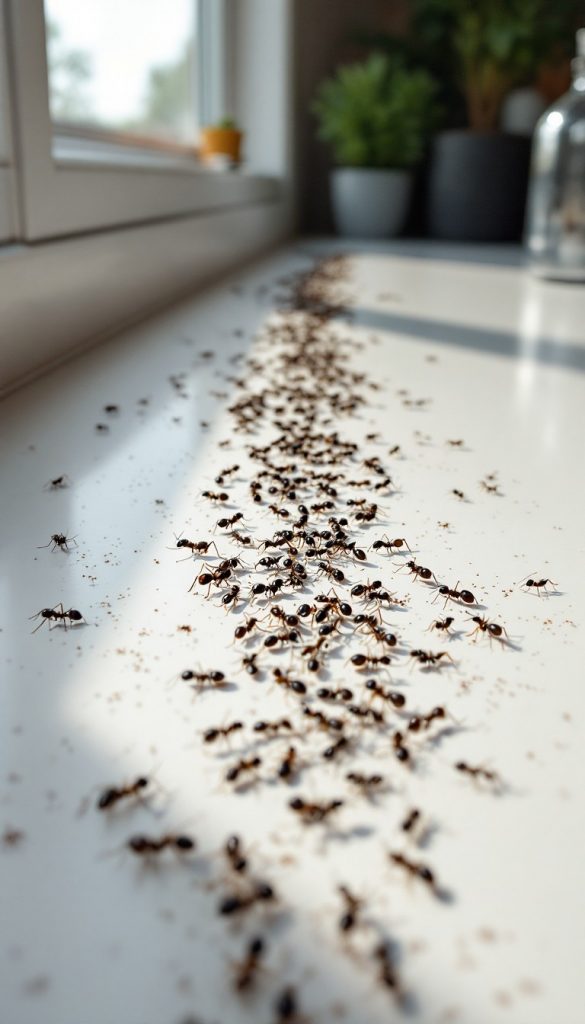
Little black ants in Seattle kitchens are almost always odorous house ants (Tapinoma sessile) the most common ant species in King County and throughout the Pacific Northwest. Their scent receptors are four to five times more sensitive than most insects, allowing a single scout ant to detect food residue completely invisible to humans a microscopic crumb behind the toaster, a thin film of juice on a countertop, or a slow drip under a sink. They emerge every spring in King County when soil temperatures climb above 50°F, typically March through June, but in Seattle’s mild climate foraging activity can occur year-round whenever indoor temperatures stay warm. Once a scout ant finds an entry point often a gap as small as 1/16 of an inch around a window frame, pipe penetration, or worn door sweep it deposits a pheromone trail within hours and hundreds of workers follow the same invisible path into your kitchen. The real colony containing anywhere from 10,000 to 100,000 workers and multiple queens is hidden in a wall void, under a concrete slab, or in soil near your foundation sometimes 20 to 50 feet from where you see ants on your counter. What you see trailing across your kitchen is less than 1% of the actual infestation. Cleaning surfaces and spraying trails eliminates only those visible workers the colony is completely untouched and replaces them within hours. The only permanent solution is professional non-repellent bait treatment that worker ants carry back to the hidden nest undetected, eliminating all queens and all workers within 7 to 14 days. Call AMPM Exterminators at (206) 571 7580 for same day service throughout King County.
Q2: Why do I suddenly have sugar ants?
Sugar ants appear suddenly in Seattle and King County homes every spring for one specific biological reason soil temperatures rising above 50°F trigger odorous house ant colonies to dramatically increase foraging activity and send scout ants in all directions searching for new food and moisture sources. In the Pacific Northwest this threshold is crossed typically between late February and early April depending on the year, which is why thousands of King County homeowners experience the same phenomenon simultaneously perfectly clean kitchens that were ant-free all winter suddenly have trails of tiny black ants within days of the first warm spell. The warm wet springs Seattle experiences accelerate this dramatically. Rain drives ants closer to foundations, warming soil triggers foraging, and the combination produces what feels like an overnight invasion. What actually happened is the colony which was present and active at lower levels all winter suddenly scaled up foraging operations in response to environmental signals. The other trigger for sudden sugar ant appearance is a failed DIY treatment from a previous season. If repellent sprays were used at any point, the colony likely budded into multiple satellite nests inside your walls during the previous treatment. Those satellite colonies now emerge in spring as independent infestations in multiple rooms simultaneously. This is why homeowners who sprayed the previous year often report far worse and more widespread activity the following spring. Professional non-repellent bait treatment eliminates all satellite colonies simultaneously, preventing this cycle from repeating. AMPM Exterminators provides same day service throughout Seattle and King County call (206) 571 7580.
Q3: Does ant spray make little black ants worse?
Yes and this is the single most important fact every Seattle homeowner needs to know before treating sugar ants or little black ants. Odorous house ants (Tapinoma sessile) respond to repellent insecticides by activating a hard wired survival behavior called colony budding. When worker ants detect a chemical threat, the colony’s multiple queens each independently relocate and establish new satellite nests in different areas away from the threat. The original colony of one location becomes three, four, or five colonies in new locations all within your home’s walls, under floors, or in crawl spaces. One over the counter spray application on a kitchen ant trail can trigger 3 to 5 new satellite colonies to establish in bedroom outlets, bathroom baseboards, living room light switches, and ceiling fixtures within 48 hours. King County homeowners report this pattern with remarkable consistency spray the kitchen trail on Monday, ants disappear Tuesday, reappear in the bedroom, bathroom, and hallway by Thursday. This is not a coincidence and it is not the spray wearing off. It is colony budding and every application of repellent spray makes it worse. The only treatment that reverses this is professional non-repellent bait. Non repellent bait is completely undetected by the ant colony’s chemical alarm system. Worker ants consume the slow-acting bait, carry it back to every satellite colony, and share it with nestmates and queens throughout the entire colony network. The entire system collapses from within no budding, no splitting, no spreading to new rooms. Most AMPM customers see dramatic reduction in ant activity within 24 to 48 hours of professional treatment and complete colony elimination within 7 to 14 days. If you have been spraying for weeks or months with store bought products, stop immediately and call (206) 571 7580 for professional non repellent treatment.
Q4: How much does ant extermination cost in Seattle?
Professional ant extermination in Seattle and King County costs vary by species, property size, and severity of infestation. Here is the complete pricing breakdown for 2026 from AMPM Exterminators:
Sugar ant and little black ant treatment (odorous house ants): $150 to $300 for an initial treatment including full inspection, species identification, targeted non-repellent bait application, exterior perimeter treatment, and a free follow up visit if ants return.
Carpenter ant treatment: $250 to $500 including comprehensive structural inspection, moisture meter assessment, wall void dust injection if satellite colonies are present, exterior perimeter treatment, damage documentation, and repair referrals if needed.
Moisture ant treatment: $200 to $400 including professional moisture meter assessment, water source identification, colony treatment, and licensed contractor referrals for the underlying water damage repair.
Quarterly prevention plan: $100 to $175 per quarter for year-round protection covering all ant species, seasonal inspections, and priority same-day emergency response.
Free inspection: AMPM Exterminators provides free inspections with no hidden fees and no obligation.
For context most King County homeowners who attempt DIY treatment first spend $60 to $150 on over-the-counter products over 4 to 8 weeks, trigger colony budding that spreads the infestation, and then pay professional treatment costs on top of that. The total DIY first cost is almost always higher than calling a professional at first sighting. For carpenter ant cases, early professional treatment at $250 to $400 prevents structural repairs that typically run $800 to $8,000 depending on how long the colony was active. Call (206) 571 7580 for a free estimate all prices quoted upfront with no surprises.
Q5: How do I get rid of little black ants fast in King County?
The fastest and most permanent solution for little black ants in King County is a professional inspection and targeted non repellent bait treatment from a WSDA-licensed exterminator same day if possible. Here is why speed and professional treatment work together better than any DIY approach:
Speed matters because odorous house ant colonies respond to disturbance by budding splitting into new satellite colonies in new locations. Every day an active colony is disturbed with repellent sprays, new satellite nests are being established deeper inside your home’s structure. Acting fast with the right professional treatment prevents this escalation.
Non-repellent professional bait is the fastest elimination method available because it works with ant biology rather than against it. Worker ants actively distribute the bait throughout the entire colony network within hours of first contact. Dramatic reduction in visible ant activity appears within 24 to 48 hours. Complete colony elimination including all queens occurs within 7 to 14 days.
While waiting for your appointment: do not spray any repellent products, do not seal outlets or baseboards where ants are emerging, do remove food attractants from counters, and do take a photo or short video of the ant trail location to show the technician trail location tells us where the nest is before we even begin the inspection.
AMPM Exterminators offers same-day ant control service across all King County cities including Seattle, Bellevue, Renton, Kirkland, Redmond, Kent, Federal Way, Burien, Tukwila, Sammamish, Issaquah, Shoreline, and all surrounding communities. Available from 6 AM to 2 AM daily with 24/7 emergency response. Call (206) 571 7580 right now for same day service.
Q6: How do I know if I have sugar ants or carpenter ants?
Size is the fastest and most reliable field test to distinguish sugar ants from carpenter ants in a Seattle home.
Here is the complete identification guide:
Sugar ants and odorous house ants measure 1.5 to 2mm smaller than a sesame seed. They are dark brown to jet black, fast-moving, and travel in erratic trails rather than steady lines. The definitive identification test: crush one between your fingers. If it produces a distinct smell of rotten coconut or blue cheese, it is an odorous house ant the most common ant in King County kitchens. Sugar ants do not damage wood and are most active during daylight hours.
Carpenter ants measure 6 to 12mm the size of a pencil eraser to a thumbnail. They are solid black or black with red coloring, slower-moving, and most active between dusk and midnight. If you see large black ants walking slowly across your walls or floors at 9 to 11 PM, these are almost certainly carpenter ants. Additional carpenter ant signs include small piles of sawdust mixed with ant body parts (called frass) appearing below baseboards, outlets, or windowsills, and winged swarmers emerging from walls in spring. Carpenter ants require completely different treatment and urgent action to prevent structural damage.
Moisture ants are the easiest to overlook they are tiny (1.5mm), yellow to golden brown, and almost translucent. Finding moisture ants means you have an active water intrusion problem in your walls right now. Do not treat just the ants call for a moisture inspection immediately.
Pavement ants are small (1.5 to 3mm), dark brown to black, and found nesting under concrete slabs, driveways, and sidewalks. They enter homes through foundation cracks and are most common in fall when seeking warmth. They rarely cause structural damage.
If you are uncertain which species you have, text a clear photo to AMPM Exterminators at (206) 571 7580 and we will identify it for you before you schedule free of charge.
Q7: Are ant treatments safe for kids and pets?
Yes and this is one of the most common concerns we hear from King County families, especially those with young children, dogs, cats, and other pets at home. Here is exactly what AMPM Exterminators uses and why it is safe:
Our primary treatment method for sugar ants and little black ants is professional non-repellent gel bait. Gel bait is a slow acting, low toxicity formulation that is placed in small targeted amounts at ant emergence points not broadcast sprayed throughout your home. The active ingredients in professional ant baits are typically indoxacarb or fipronil at concentrations of 0.05% or less far lower than any spray product. Bait stations contain such minimal amounts of active ingredient that the EPA classifies them among the lowest toxicity category for pest control products.
For carpenter ant wall void treatment, we use insecticidal dust injected through small access holes into wall cavities where the colony lives. The dust remains inside the wall void it is not accessible to children or pets on surfaces they contact.
Every product AMPM uses is applied by Washington State Department of Agriculture licensed technicians who follow all label safety protocols. We explain the exact product name, active ingredient, application location, and re-entry interval before we apply anything in your home. We do not begin treatment until you are completely comfortable with what is being used.
We recommend keeping children and pets out of treated areas for 30 to 60 minutes while application dries after that, surfaces are safe for normal contact. For families with severe chemical sensitivities, we offer fragrance-free and reduced-chemical treatment options. Ask about these when you call. Pet-safe and child-safe treatment is not a special request at AMPM it is our standard protocol for every service we provide.
Q8: How long does ant treatment last?
A single professional ant treatment from AMPM Exterminators eliminates an active infestation within 1 to 4 weeks depending on species and colony size. Here is the detailed timeline and what to expect after treatment:
Days 1 to 3: You may see increased ant activity immediately after treatment. This is normal and expected worker ants are contacting the bait and becoming disoriented as it takes effect. Do not spray or disturb ant activity during this period. Interfering with the bait distribution process slows colony elimination.
Days 4 to 7: Ant activity begins declining noticeably. Trails become smaller and less organized as worker ant numbers decrease and queen egg production is disrupted.
Days 8 to 14: Activity drops dramatically. Most customers report near-zero visible ant activity by day 10 to 12 for odorous house ant infestations. Carpenter ant colonies, which are larger and slower-acting, may take 10 to 14 full days for complete elimination.
Day 14 to 21: AMPM Exterminators returns for a free follow-up visit to confirm complete elimination, seal entry points now that the colony is gone, and apply preventive exterior barrier treatment.
How long does protection last after treatment? A single treatment permanently eliminates the existing colony. New colonies can establish from outside if conditions that attracted ants food sources, moisture, entry points are not addressed. For year-round protection, AMPM’s quarterly prevention plan at $100 to $175 per quarter includes seasonal inspections, preventive barrier treatment, and same-day emergency response if any new activity appears.
Important: If ants return within 30 days of treatment, AMPM Exterminators returns at no additional charge. Our 30 day warranty is included with every service. For carpenter ant cases where moisture conditions are present, permanent prevention requires addressing the underlying moisture source in addition to ant treatment our technician will identify and document the moisture source during the initial inspection.